Leeds
A Woman of SubstanceLeeds is both the setting of Emma Harte’s decisive rise and the material basis of the power she spends a lifetime accumulating. First imagined as a place where a working-class girl might make a fortune, it becomes the city where she finds work, conceives her own shop, builds a chain of businesses, and ultimately directs a commercial empire. Its significance rests not on a single landmark but on the interlocking worlds of textile production, retail, labor, finance, and transport that Emma learns to enter and control.
Industrial setting and textile foundations
Leeds is introduced as a major industrial centre in northern England, associated with clothing factories, woollen mills, iron foundries, engineering companies, cement works, and printing plants. Emma later travels through its centre past factories and buildings that she owns, as well as the department store bearing her name. The city’s scale and range of industries give concrete form to her success: the wealth she acquires is not abstract, but rooted in workplaces, property, goods, and the movement of trade.
The region’s geography helps explain the importance of textile manufacturing. Fairley village lies in the Pennine foothills, within a landscape whose geology and water supply vary from one district to another. In the West Riding, millstone grit country supports coarse grass and short-haired sheep, while streams supplied by rain-bearing winds provide soft water. Wool and soft water are identified as essential to cloth-making, and both are plentiful in the region. The account connects Leeds’s industrial growth to the material conditions around it: local land and water support the production on which its mills depend.
The city is also presented as a place of expanding opportunity. Blackie O’Neill describes new manufactories, mills, foundries, building work, and a growing population of employers and workers. His own business with his uncle, Pat O’Neill, repairs and builds for mill owners and the gentry. Leeds’s growth is therefore visible not only in large factories but in the supporting trades that serve them. For Emma, this account opens a possibility that village life has not offered: money can be earned through work and enterprise rather than received by inheritance.
The city imagined and entered
Before Emma reaches Leeds, it exists in her mind through Blackie’s descriptions. He recounts its restaurants, dance halls, theatres, and horse-free tramcars, presenting an urban world of mobility and leisure as well as employment. Yet the detail that most affects her is the prospect of making a fortune. Fine clothes and entertainment recede beside the possibility of gaining financial independence. Emma asks whether a girl like her could succeed there, and Blackie offers practical ways to find him through Rosie Miller at The Mucky Duck or at the Golden Fleece on Briggate. His account makes Leeds both alluring and navigable: it suggests a route into the city, even as its social and economic risks remain real.
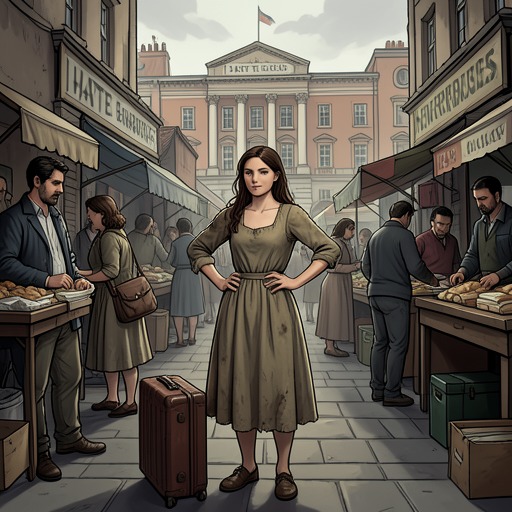
Emma’s first encounter with the labor market is considerably harsher than that promise. After arriving, she spends four days visiting shops on Briggate and nearby streets, looking for any job, including menial work. She finds no openings. The pavements she had associated with easy prosperity become a test of endurance, and the factories, warehouses, foundries, printing works, and offices appear as imposing structures rather than immediate sources of employment. Still, their scale strengthens her resolve. She recognizes Leeds as the place where her future lies and begins to imagine wealth and power as outcomes she can pursue.
The turning point comes as Emma studies the shops along Boar Lane. Their displays of clothing, household objects, and ornaments help her turn a vague ambition into a business idea: she will open a shop selling everyday necessities. Retail becomes her chosen route into the city’s economy. When she later reaches Armley, she sees another possible starting point. Its shopping street includes a fishmonger, haberdasher, chemist, and dress establishment; the area seems promising because rents may be lower than in Leeds itself. She imagines opening her first shop there after the baby is born. The movement between Leeds and Armley shows her learning to assess locations not simply as places to admire but as commercial opportunities with differing costs and customers.
Work, skill, and business growth
Emma’s entry into Leeds also takes place through manufacturing labor. After failing to find shop work, she searches the tailoring shops on North Street and encounters Abraham Kallinski being assaulted. Her attempt to help him brings her into contact with his family and their clothing business. She explains that she had looked for work in Leeds’s fancy stores without success before trying the tailoring shops. The episode links her search for a livelihood to the city’s immigrant garment trade and to the discrimination and harassment that Jewish residents describe having fled in Russia and Poland.
Her later employment at Thompson’s mill offers a contrasting experience of industrial work. Emma dislikes its rigid discipline and harsh overseers, and on her third day she witnesses a shuttle accident that leaves a worker scarred. The account sets the conditions there against the more companionable atmosphere she had known at Abraham Kallinski’s small factory. Leeds’s economy offers routes to advancement, but those routes depend on workplaces with sharply different cultures and conditions. Emma’s own skill with a needle becomes important beyond her wage work: by day she works at the mill, and by night she designs, cuts, and sews clothes for a growing local clientele. Laura Spencer’s recommendations help bring customers, while Emma’s flair and reasonable prices sustain the trade.
The scale of her business gradually changes. Emma invests in David Kallinski’s first clothing factory on York Road, designs a line of women’s clothes, and treats the investment as a way to make capital productive. Her commercial activity joins design, manufacturing, and finance rather than remaining confined to shopkeeping. During the war, she and David suspend the Lady Hamilton clothing line and redirect the factory’s production to uniforms. Meanwhile, their mill meets substantial government contracts, and their enterprises remain profitable despite the disruption. Leeds serves as the operating centre for this flexible industrial network, where products and production can be reorganized in response to wartime demand.
Emma also establishes herself in department-store retail. She buys a store in the latter part of 1912, renovates and modernizes it with Blackie O’Neill’s assistance, and opens it in January 1913. Later, dressed in a severe black silk outfit that Joe calls the Harte uniform, she studies the store’s ledgers at her desk before the business day has fully begun. The scene places her authority in the daily practices of management: accounts, inventory, security, and attention to detail. Her department store is not merely a public emblem of success; it is an enterprise she continues to scrutinize closely.
Business power, risk, and the wider market
Leeds remains central as Emma’s commercial holdings expand. Her enterprises include the department store, mills, a clothing factory, and warehouse stock. During the war she manages shortages by allocating stock carefully and finding new sources of supply. Layton’s mill, under Ben Andrews, meets large government orders, while the factory’s change to uniform production turns a former fashion line into wartime output. These decisions show how the city’s businesses respond to scarcity and shifting demand without ceasing to function as a connected system.
Emma also watches financial developments beyond the city. A clipping from the Financial Times reports the London Stock Exchange’s closure and the raising of the bank rate from four to eight per cent; she reads these actions as signs of the seriousness of the crisis and considers their purpose in preventing panic and limiting the outflow of gold. Leeds is therefore not isolated from national finance. Emma’s business decisions in the city are informed by events in London and by the risks facing the broader economy.
Her commercial rivalry with the Fairley family is likewise tied to Leeds and its surrounding industrial region. Emma identifies Adam and Gerald Fairley as her principal targets because they control the Fairley mills and the family fortune. She has already made it difficult for them to replace workers she recruited from Thompson’s mill, and she gathers detailed information about their holdings and commercial position in secrecy. Her strategy turns knowledge of labor and business into leverage. Leeds is not only where she builds her own wealth; it is the base from which she can challenge the established industrial power of the Fairleys.
By the postwar period, the city’s commercial life has expanded again. Emma’s store is profitable, and increased demand in the cloth trade makes Layton’s a larger money-maker than before. Orders arrive from around the world, and workers are put on overtime to meet them; Gregson Warehouse is operating again. Emma has also sold much of the property Joe left her while retaining a plot in central Leeds because she expects its value to rise. The city’s assets thus include land as well as active businesses, and Emma treats both as elements in a long-term strategy.
A seat of power and a place of return
The novel’s retrospective view makes the relationship between Leeds and Emma explicit. Driving through the city, she passes buildings and factories she owns and the great department store named for her. Leeds appears as the foundation of her wealth and the seat of her power. In an empty hall, she reflects on the scale of what she has achieved and wonders where she found the energy to do it. She has rarely paused to consider her success, leaving that accounting to competitors and adversaries. Her own understanding of the Harte enterprise contrasts with their assumptions: she attributes its construction to honesty, courage, patience, and sacrifice rather than duplicity and ruthlessness.
The city remains a working centre even as Emma’s responsibilities broaden. After reorganizing her business so she can spend more time in London, she appoints Winston Harte managing director of the Yorkshire shops and mills and supervises the northern industries from her Knightsbridge headquarters. She travels to Leeds monthly, spending five demanding days working with him. This change redistributes management without displacing Leeds from the structure of her enterprise. It remains the place where important parts of the business operate and where her authority is exercised through regular oversight.
Leeds also contains institutions and relationships that connect Emma’s private life to her business world. When Winston is wounded at sea, his ship reaches Hull, and he is taken to Chapel Allerton Naval Hospital in Leeds. After surgery and rehabilitation, he lives with Emma during his recovery and travels to the hospital for physical therapy in a Harte van. The hospital is part of the city’s wartime landscape, while Emma’s transport and household provide practical support. On Victory in Europe Day, she celebrates in Leeds with Winston and Charlotte, feeling relief that her sons, sons-in-law, and the families of Blackie O’Neill and David Kallinski have survived the war.
Leeds’s importance is therefore cumulative. It begins as an imagined escape from the village, becomes a difficult labor market and a place where Emma learns to identify commercial openings, and develops into the home of shops, mills, manufacturing, and finance under her control. Its industrial resources and urban markets make her rise possible, but the city does not guarantee success: Emma must withstand unemployment, evaluate workplaces, acquire skills, manage risk, and repeatedly adapt production. By the time she sees the businesses that bear her name, Leeds has become more than the setting of her achievement. It is the geography through which her ambition has been converted into durable economic and familial power.